What Is Virtual Staging? A Guide to Transforming Empty Rooms
Virtual staging is the art of digitally adding stylish, photorealistic furniture and decor to photos of empty rooms. Think of it as a digital makeover for a property, letting you furnish an entire home to showcase its true potential without ever lifting a single box. The goal is to help buyers see a house as their future home, sparking that crucial emotional connection that leads to a sale.
Why Virtual Staging Matters Now
Trying to sell a story with blank pages is tough. That’s exactly what an empty room feels like to a potential buyer—a space full of questions instead of inspiration. Unfurnished properties often feel smaller and less inviting, forcing buyers to guess how their own lives might fit inside. Virtual staging completely flips that script, turning those blank pages into a compelling visual story.
It’s a smart marketing strategy that transforms cold, vacant listings into warm, aspirational homes that people can actually picture themselves living in.
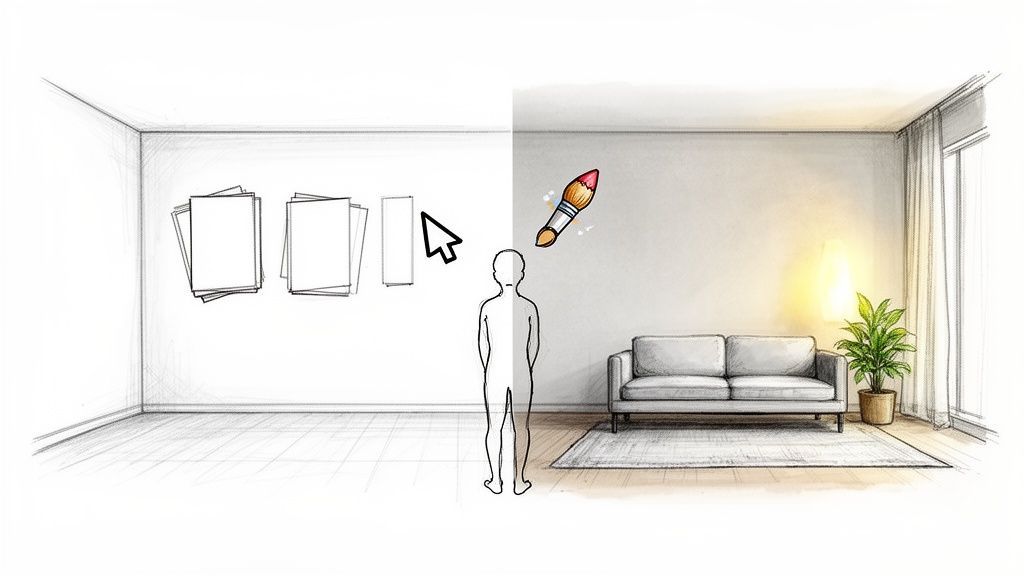
This modern approach isn't just about dropping in a digital sofa. It’s about creating an experience that resonates with a specific audience and tells a story that makes a property unforgettable in a crowded online market.
By presenting a move-in-ready vision, you can:
- Forge an Emotional Connection: Buyers aren't just buying walls and floors; they're buying a lifestyle. Staging helps them see themselves relaxing, entertaining, and making memories in the space.
- Demonstrate a Room’s Potential: Is that spare room a home office, a nursery, or a guest bedroom? Virtual staging can instantly showcase its versatility, appealing to a much wider range of buyers.
- Set a Premium Tone: A beautifully staged home immediately communicates value and care. This helps justify a higher price point and attracts serious, qualified buyers from the get-go.
In a market where the first showing almost always happens online, virtual staging is an essential tool. It bridges the gap between an empty space and a dream home, allowing you to shape a buyer's first impression before they even step inside.
And this isn't just for big agencies with huge budgets anymore. The rise of accessible, AI-powered tools like Molda has made it easy for individual agents, stagers, and designers to create stunning, persuasive listings. Instead of just hoping a buyer can see past empty floors, virtual staging empowers you to show them exactly what's possible.
The difference it makes is clear when you compare a standard listing with a virtually staged one.
Virtual Staging at a Glance
This quick comparison shows how virtual staging can completely change a buyer's perception of a property.
| Attribute | Empty Property Listing | Virtually Staged Listing |
|---|---|---|
| First Impression | Cold, impersonal, and uninspiring. | Warm, inviting, and full of possibility. |
| Buyer Engagement | Low. Buyers often scroll past quickly. | High. Captures attention and encourages clicks. |
| Emotional Connection | Difficult for buyers to form a connection. | Helps buyers visualize living in the space. |
| Perceived Value | Can feel smaller and less valuable. | Appears more valuable and justifies the price. |
Ultimately, virtual staging helps turn online clicks into in-person showings and interested prospects into new homeowners.
How Virtual Staging Brings a Space to Life
Turning an empty room into a beautifully furnished home isn't magic—it's a clever mix of digital artistry and powerful technology. The goal is always the same: to take a blank canvas and paint a picture so compelling that a buyer can see themselves living there.
Traditionally, this was the exclusive domain of skilled 3D artists. But today, AI has thrown the doors wide open, offering a much faster and more flexible way to get the job done. Let's look at how both methods work.
The Traditional 3D Artist Method
Think of the classic approach as digital craftsmanship. A 3D artist takes a photo of an empty room and, using sophisticated software, begins the meticulous process of building the scene from scratch. It’s part interior design, part digital construction.
To make it look real, they have to nail a few key things:
- Scale and Perspective: Every single piece of furniture—from the couch to the lamp on the side table—has to fit the room's dimensions and perspective perfectly. If it's even slightly off, the whole image feels wrong.
- Lighting and Shadows: This is where the real artistry comes in. The artist has to manually paint in shadows and reflections that match the natural light coming from windows or the glow from a light fixture.
- Texturing: To avoid a fake, video-game look, artists apply detailed textures to every surface. You can almost feel the weave of the rug or see the grain in a wooden coffee table.
This hands-on process yields stunning, photorealistic results. The downside? It’s slow. A single image can easily take 24 to 48 hours to complete, often with a lot of back-and-forth to get the style just right.
This method is like commissioning a custom piece of art. It’s precise and high-quality, but it’s not built for speed or high-volume projects.
The Modern AI-Powered Approach
New platforms are completely changing the game by using artificial intelligence to do the heavy lifting. Instead of waiting on a human artist, AI can generate entire design concepts in a matter of minutes.
The process is incredibly straightforward. You upload your photo of the empty room and tell the AI what you want with a simple text prompt, like "a cozy Scandinavian living room with a leather sofa and warm lighting."
The AI gets to work instantly, analyzing the room's architecture, size, and existing light sources. Within moments, it generates several fully furnished design options that match your prompt. This means you can experiment with completely different looks—from Japandi to Industrial to Mid-Century Modern—almost instantly.
You can learn more about how to use virtual staging to create compelling real estate listings and see firsthand how powerful this technology has become.
This shift gives real estate agents and designers an incredible amount of speed and creative control. Forget waiting days for a revision—now you can produce dozens of variations on the fly, tailoring the home's style to different buyers without needing any design skills or special software.
The Real-World Benefits for Sellers and Agents
Sure, gorgeous photos are a nice perk, but the real power of virtual staging is what it does for the bottom line. For sellers and real estate agents, this isn't just about making a listing look pretty; it's about making it perform—selling faster and for a better price. The financial argument alone is a game-changer.
Let's start with the most obvious win: the cost savings. Traditional physical staging is a serious investment, often running into thousands of dollars for furniture rental, movers, and a stager's time. Virtual staging delivers that same polished look for a tiny fraction of the cost—some reports show it can be up to 95% cheaper. That kind of efficiency makes top-tier marketing accessible for absolutely any listing, not just high-end properties.
Boosting Online Engagement and Buyer Interest
In a world where the first showing happens online, you have milliseconds to grab a buyer's attention. This is where virtual staging really shines. It transforms cold, empty photos into warm, inviting homes that make people stop scrolling and start clicking. That initial visual appeal is everything when it comes to driving traffic and getting your phone to ring.
This isn't just theory; the results are measurable. Listings that use virtual staging consistently outperform those that don't. For example, properties staged with modern AI tools have seen a 72% jump in online traffic and a 44% increase in qualified buyer inquiries. It gets better. Those numbers often lead to a property spending 36% less time on the market while selling for as much as 22% more. You can explore more about how these numbers are shaking up competitive real estate markets.
Unlocking Marketing Versatility
Virtual staging gives you a level of marketing flexibility that's simply impossible with physical furniture. Think about that awkward spare room. Is it a home office? A nursery? A guest bedroom? With virtual staging, it can be all three. You can create different versions to appeal to different types of buyers.
- Target Different Buyers: Show a sleek, minimalist setup for young professionals, then swap it for a cozy, traditional look for a growing family.
- Show the Potential: You’re not just selling rooms; you’re selling a lifestyle. Help buyers visualize themselves in the space by showing them exactly how it can be used.
- Move at Market Speed: Generate multiple design options in minutes. This lets you adapt your marketing on the fly without waiting weeks for a stager.
The infographic below breaks down the key differences between the old-school artist approach and today's AI-powered platforms.
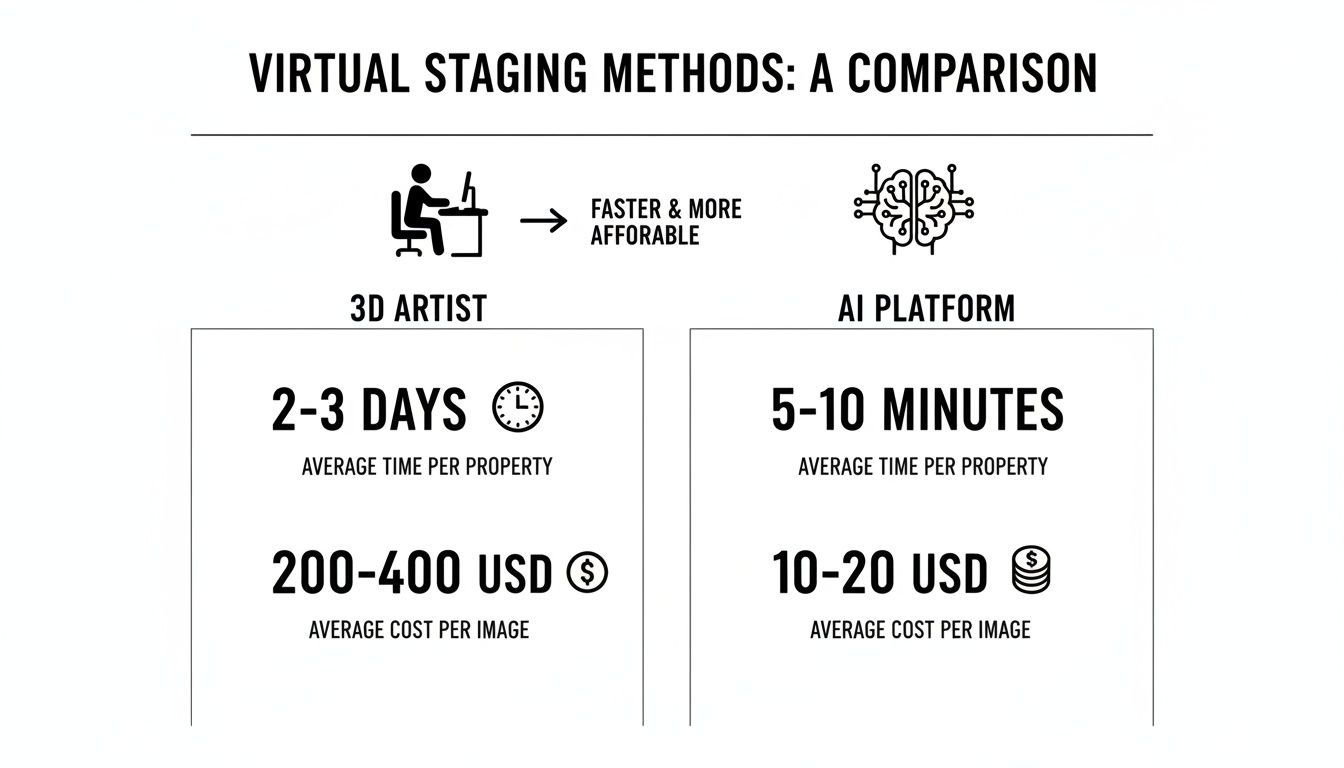
As you can see, modern AI tools deliver incredible speed and savings without compromising on quality. For more ideas, see our guide on how virtual staging empowers real estate professionals to gain a competitive edge.
In the end, virtual staging flips the script from reactive to proactive marketing. Instead of just showing an empty house and hoping a buyer has a great imagination, you’re actively guiding their first impression and building an emotional connection from the very first click. That’s what leads to more showings, better offers, and quicker sales.
Virtual Staging vs Physical Staging Compared
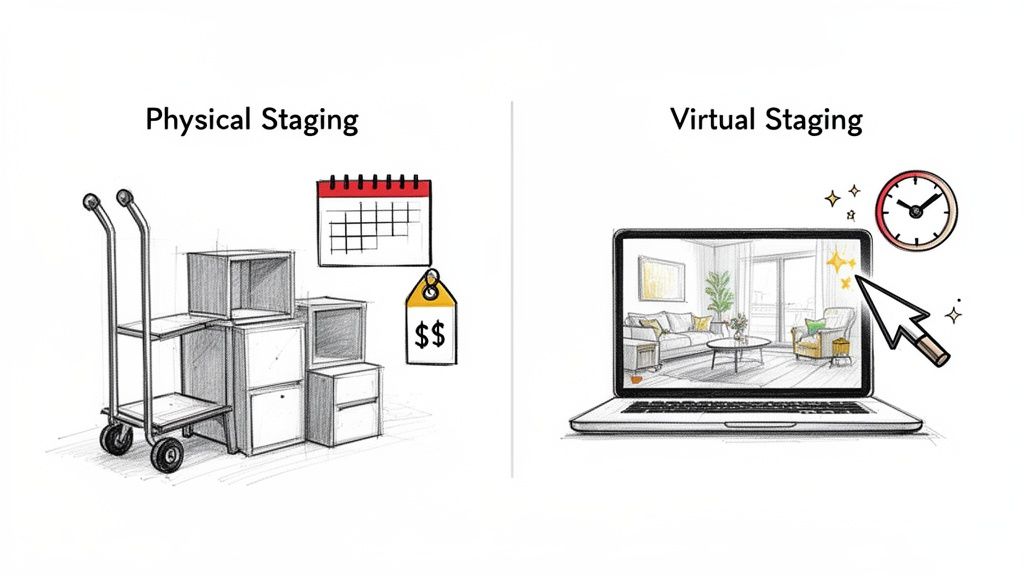
When it comes to showing a property in its best light, you've got two main choices: virtual staging and good old-fashioned physical staging. They're two very different paths to the same goal.
Think of physical staging as the classic approach. It involves renting real furniture, hiring movers, and having a professional meticulously arrange every piece inside the home. It’s tangible and can be very effective, but let’s be honest—it’s also a massive undertaking in terms of time, money, and coordination.
Virtual staging, on the other hand, is the modern, digital answer to this challenge. It accomplishes the exact same thing—making an empty space feel like a welcoming home—but it all happens on a computer screen. This method sidesteps the physical labor and inventory headaches, offering a much faster, more nimble, and incredibly budget-friendly alternative.
Cost and Time: A Head-to-Head Battle
The most dramatic difference between these two methods boils down to money and speed. Physical staging isn't cheap. You’re easily looking at costs ranging from $1,500 to over $7,000, once you add up furniture rental fees, delivery charges, and the stager's professional time. The whole process, from the initial consultation to getting photos back, can easily stretch over several weeks.
Virtual staging completely flips that script. Instead of thousands, you’re typically paying between $29 and $99 per image. For what it costs to rent physical furniture for just one month, you could virtually stage an entire house in several different design aesthetics. And the turnaround? It's lightning-fast. High-quality virtually staged images are usually ready in just 12 to 48 hours. Not weeks.
For real estate professionals working in a fast-paced market, this is a game-changer. Virtual staging means you can get a property listed almost instantly, grabbing buyer attention right away and kickstarting the sales cycle.
Flexibility and Logistics
Beyond the budget and timeline, virtual staging unlocks a level of creative freedom that physical staging just can't touch. When you're working with real furniture, you're stuck with what's available in the warehouse and committed to a single look.
Virtual staging throws those limitations out the window. It allows you to:
- Showcase Multiple Styles: Not sure if your ideal buyer prefers modern minimalist or cozy farmhouse? No problem. You can create both versions for the same living room and see what resonates.
- Demonstrate Room Versatility: That spare bedroom can be a home office, a nursery, and a fitness room, all at the same time. This helps different buyers envision themselves in the space.
- Avoid Physical Hassles: Forget about coordinating movers, worrying about scratched floors, or disrupting sellers who might still be living in the home. It's a clean, seamless process.
To make the comparison crystal clear, here’s a straightforward breakdown of how the two methods stack up against each other.
Comparison: Virtual Staging vs Physical Staging
This table offers a direct comparison of virtual and physical staging, highlighting the key factors that real estate professionals and designers need to consider.
| Factor | Virtual Staging | Physical Staging |
|---|---|---|
| Average Cost | $29 - $99 per photo | $1,500 - $7,200+ per property |
| Timeline | 12 - 48 hours | 1 - 2 weeks |
| Flexibility | Limitless design options and styles | Limited to available inventory |
| Logistics | Simple photo upload | Complex coordination of movers and rentals |
As you can see, while both have their place, the advantages of virtual staging in terms of cost, speed, and creative potential are hard to overlook for most modern marketing needs.
The Rapid Growth and Future of Property Marketing
Virtual staging isn't just a gimmick for luxury listings anymore. It’s quickly becoming a non-negotiable part of selling property in the modern market. What started as a clever workaround to physical staging has exploded into a standard practice, largely because of how we all shop for homes now—online first. This isn't just a minor trend; it’s a fundamental shift in how real estate deals get done.
The numbers back this up in a big way. This whole approach has completely flipped property marketing on its head, especially as more people started their home search from their couch. According to a recent study, the global Virtual Staging for Real Estate market was valued at US$388 million and is on track to hit a massive US$1,906 million by 2031. That's a compound annual growth rate of 25.8%. You can explore the full market projections to see just how fast this is all moving.
The Democratization of High-End Design
So, what's fueling this massive growth? A huge part of the story is artificial intelligence. It wasn't that long ago that creating a photorealistic rendering meant hiring a specialized 3D artist with expensive software, which was a dealbreaker for most budgets. Today, AI has completely changed the game.
New AI platforms have put high-end design tools into the hands of just about everyone. A solo real estate agent or a small design studio can now create visuals that rival what a big firm with a huge budget could produce. This tech lets you mock up multiple design concepts for a room in a matter of minutes, offering a kind of speed and creative freedom we just didn't have before.
The future of property marketing is instant, intelligent, and interactive. AI-powered visualization is no longer a "nice-to-have" but a core component of a successful sales strategy, allowing professionals to tell a more compelling story for every listing.
What this really means is that any property, at any price point, can be shown at its absolute best.
What Lies Ahead for Property Visualization
Looking down the road, AI is only going to get more integrated into the process, making property marketing feel even more personal and immersive. We're already starting to see the next wave of innovation take shape. Expect to see more of:
- Interactive Staging: Imagine potential buyers playing around with furniture and decor in real-time while taking a virtual tour.
- Augmented Reality (AR): Clients will be able to hold up their phone in an empty room and see exactly how virtual furniture would look in the physical space.
- Predictive Design: We'll likely see AI that suggests the best staging style based on the home's location and the kind of buyer it's likely to attract.
At the end of the day, the future of real estate is visual. As these tools continue to evolve, instant, AI-driven visualization will become as essential as professional photography is today. It's simply the new standard for selling and designing homes.
Choosing the Right Virtual Staging Solution
Picking the right virtual staging partner is one of the most important decisions you'll make for your listings. The goal is to get results that truly captivate buyers, but the path to get there can look very different. Your options range from freelance artists to sophisticated AI platforms, and the best fit really hinges on what you value most—be it quality, speed, or budget.
The market for this stuff has absolutely exploded since it started gaining steam in the mid-2010s, and it's not slowing down. Valued at US$388 million today, the industry is on track to hit US$1,906 million by 2031. That’s a clear sign of just how essential virtual staging has become in modern real estate marketing.
Key Factors in Your Decision
So, how do you sift through the noise? It helps to have a clear framework for making a decision. Focusing on a few core criteria will help you find a solution that genuinely supports your business goals instead of just adding another task to your plate.
Here’s what you should be looking at:
- Quality of Renders: This is non-negotiable. Does the furniture actually look like it belongs in the room? Pay close attention to the shadows, lighting, and textures. A bad render with floating furniture is often worse than an empty room.
- Turnaround Time: How fast do you need to move? Traditional services might take 24-48 hours, which can feel like an eternity in a hot market. Newer AI platforms, on the other hand, can spit out multiple design options in less than a minute.
- Ease of Use: You shouldn't need a degree in graphic design to stage a room. The platform should feel intuitive, with a simple upload process and easy-to-browse style options. The less friction, the better.
- Pricing Model: Do the math. Some providers charge per image, while others use a credit-based system. If you're staging dozens of properties a month, AI platforms offering bulk credits will almost always be more cost-effective.
Ultimately, the right solution is a strategic partner. It should enhance your marketing, save you time, and deliver a reliable return on investment by making your properties irresistible to online buyers.
Finding that perfect fit is all about balancing these factors. To help you get started, we put together a detailed guide comparing the best virtual staging software on the market today.
Frequently Asked Questions About Virtual Staging
As you get ready to work virtual staging into your projects, you’ll naturally run into a few questions. Getting a handle on the costs, ethics, and what the technology can actually do will help you use it with confidence. Let's tackle some of the most common ones.
Is Virtual Staging Misleading to Buyers?
This is a big one, and a fair question. The short answer is no—as long as it’s done right. Good virtual staging isn’t about hiding a home’s flaws; it’s about showing its potential. Think of it like a professional photographer using the best lighting and angles to make a room look its best. It's a marketing tool meant to spark a buyer's imagination.
The trick is to be completely transparent. Honesty is always the best policy.
- Disclose Everything: A simple watermark or a note in the listing description that says "Virtually staged for illustration" is standard practice.
- Show Before and After: The best approach is to show photos of the empty room right alongside the staged version. This gives buyers the full story.
Doing this sets clear expectations, so there are no surprises when someone shows up for a tour. It builds trust right from the start.
What Does Virtual Staging Actually Cost?
The price difference between virtual and physical staging is night and day. Hiring a 3D artist to virtually stage a room has traditionally cost anywhere from $30 to $150 per photo. But newer AI platforms have completely changed the game, making it far more accessible.
With modern AI-powered tools, the cost can plummet to less than a dollar per image, particularly if you buy credits in bulk. This shift means you can experiment with dozens of design styles for a single property without worrying about the budget.
Can You Virtually Stage a Room That Already Has Furniture In It?
Absolutely. This is often called virtual renovation or item removal. It’s a two-step process. First, a designer or an AI tool digitally erases the existing furniture, clutter, or dated decor from the photograph.
Once the room is "empty," it's a blank canvas ready for virtual staging. Advanced tools can now do this entire sequence in one go, letting you pull off a complete redesign without lifting a finger. It's an ideal solution for occupied homes or for giving dated interiors a modern facelift for marketing photos.
Ready to turn those empty listings into captivating, must-see properties in a matter of seconds? With MoldaSpace, you can generate photorealistic, professionally styled interiors with just a photo and a simple text prompt. Stop letting empty rooms kill your listing’s potential. Try it today and see how easy it is to create stunning visuals that sell.