AI for Real Estate Marketing That Actually Sells Properties

So, what is "AI for real estate marketing," really?
Let's cut through the noise. It’s not about robot overlords taking over your job. Think of it more like having the world’s most efficient assistant—one that can instantly stage an empty home in ten different styles, write a compelling listing description at 2 AM, or sift through your leads to flag the ones who are ready to buy.
This isn't some far-off, futuristic concept. It's a set of practical tools available right now, designed to handle the repetitive, time-sucking tasks that get in the way of what you do best: building relationships and closing deals.
AI works by spotting patterns and making smart predictions, much like an experienced agent does, but on a massive scale. It can analyze thousands of property photos to learn what makes a kitchen feel "bright and modern" or study market data to pinpoint the perfect moment to launch an ad campaign.
Why Is Everyone Talking About AI Now?
This isn't just another industry fad; it's a fundamental shift driven by serious investment and real results. The market for AI in real estate is booming, growing from $222.65 billion in 2024 to a projected $303.06 billion in 2025.
That’s a massive 36% jump in a single year, which tells you one thing: AI has officially moved from the "nice-to-have" column to the "must-have" list for serious professionals. You can dive deeper into these trends with more real estate marketing statistics.
So, what does this actually mean for your day-to-day workflow? It means you can:
- Stop Doing the Grunt Work: Let AI handle the first draft of your property descriptions or the endless follow-ups with lukewarm leads.
- Give Clients an Amazing Experience: Use chatbots to provide instant answers 24/7 or show a buyer exactly how that empty spare room could become their dream home office.
- Make Smarter Bets: Use real data to guide your marketing spend, ensuring you're targeting the right people with the right message every time.
AI takes over the tedious data crunching and content creation, freeing you up to focus on the irreplaceable human side of the business—building trust, negotiating offers, and being the expert your clients need.
Powerful Ways AI Is Transforming Property Marketing
Let's be clear: artificial intelligence isn't some far-off concept anymore. It's a practical toolkit that top-performing agents are using right now to get a serious edge in the market. At its core, AI for real estate marketing is about automating the repetitive, time-sucking tasks while unlocking deep analytical insights to create personalized client experiences on a massive scale.
Think of it as your ultimate assistant. AI can sift through thousands of data points to predict which marketing message will click with a specific buyer, or it can pinpoint the perfect time to post a new listing for maximum engagement. It takes the guesswork out of your strategy and replaces it with data-driven precision, leading to better leads and faster sales.
This diagram breaks down how AI fits into the three key areas of the business: automating tasks, engaging clients, and closing deals.
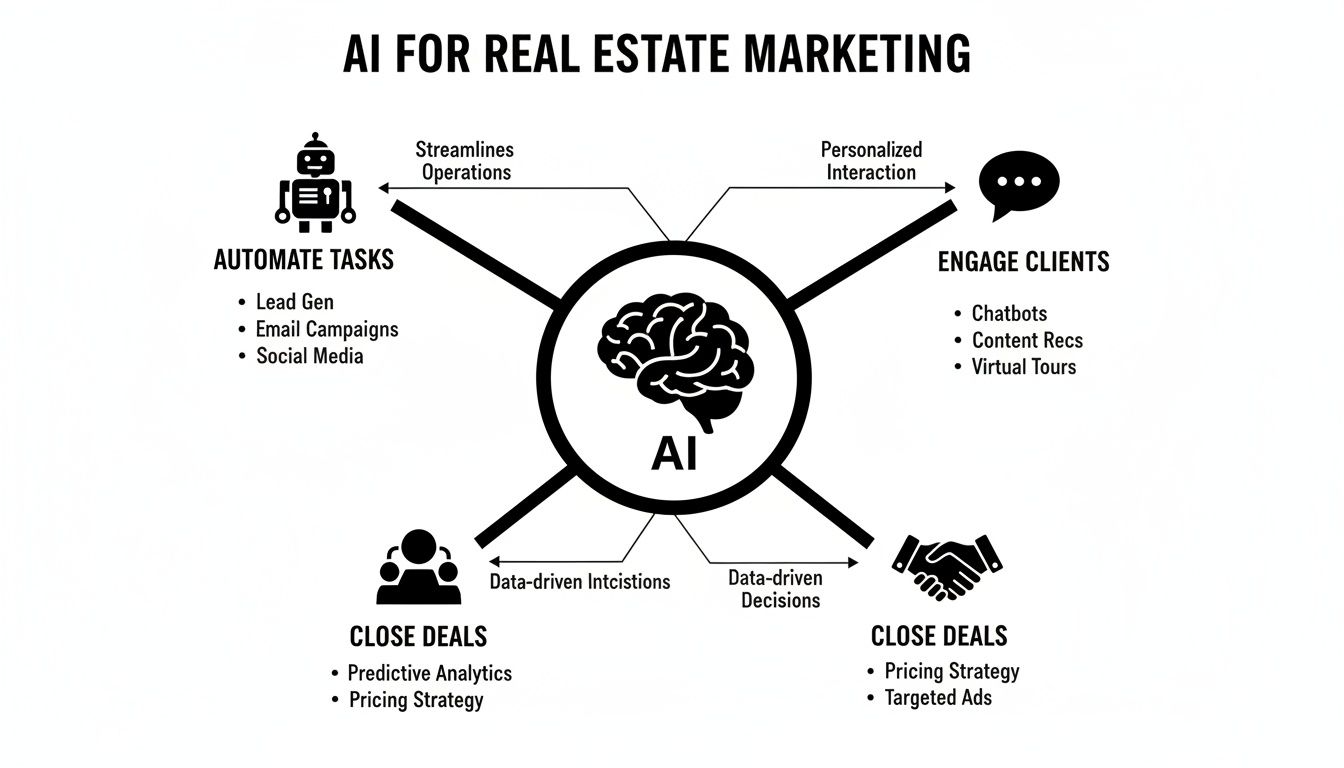
As you can see, AI supports the entire sales cycle, from the first marketing touchpoint all the way to the final handshake.
Here's a quick look at the most common ways AI is being put to work in real estate marketing, solving everyday problems with smart, automated solutions.
| AI Application | Problem Solved | Key Benefit |
|---|---|---|
| Virtual Staging & Renders | Empty properties feel unappealing and hard for buyers to visualize. | Instantly furnishes vacant spaces, creates an emotional connection, and saves thousands on physical staging costs. |
| Lead Scoring & Chatbots | High volume of low-quality leads and slow response times. | Prioritizes the most promising leads and provides 24/7 engagement, boosting conversion rates. |
| Automated Descriptions | Writer's block and inconsistent, time-consuming listing copy. | Generates compelling, SEO-friendly property descriptions in seconds, saving hours of work. |
| Ad Optimization | Wasted ad spend on campaigns that don't perform well. | Maximizes marketing ROI by automatically finding the best ad creative, audience, and budget allocation. |
These tools are no longer just "nice-to-haves"; they're becoming essential for agents who want to stay competitive and focus their energy where it matters most—on their clients.
Instantly Stage and Visualize Properties
One of the most powerful and immediate uses of AI is virtual staging. An empty room is a sales killer. In fact, a staggering 90% of buyers say they can't properly visualize the potential of a vacant space. AI completely erases this problem.
Instead of shelling out thousands for physical staging, you can just upload a photo of an empty room. A tool like MoldaSpace can furnish it in seconds with different styles, from modern farmhouse to sleek minimalist. This not only makes your listings look incredible online but helps buyers build that crucial emotional connection before they even visit. The best part? You can show off multiple design possibilities with just a few clicks.
Supercharge Lead Engagement and Scoring
Let’s face it, not all leads are created equal. AI-powered CRMs can analyze a lead's behavior—which properties they click on, how long they browse your site, which emails they open—and assign a "lead score." This is a game-changer, allowing you to focus your follow-up efforts on the people who are genuinely ready to make a move.
On top of that, AI chatbots are revolutionizing initial client contact. They offer instant, 24/7 answers to common questions, schedule viewings, and gather key information from potential buyers when you're busy. These tireless digital assistants ensure no lead ever falls through the cracks.
Automate Compelling Listing Descriptions
Writer's block can bring productivity to a screeching halt. AI writing assistants can craft engaging, detailed, and SEO-friendly property descriptions in moments. Just feed the AI the key details—square footage, number of bedrooms, unique features—and it will spin up a compelling story that makes the property shine.
This isn't just a time-saver; it ensures all your listings have consistent, high-quality copy. You can even generate a few different versions to A/B test and see what resonates most with buyers, all without staring at a blinking cursor. Find out more on how to elevate your real estate listings using these modern tools.
Optimize Your Digital Advertising Spend
Running ads on platforms like Facebook and Google can feel like throwing money at a wall and hoping some of it sticks. AI algorithms change that by dramatically improving campaign performance. These systems are constantly analyzing data to figure out which ad images, headlines, and audiences are actually bringing in the best results.
Here’s what that looks like in the real world:
- A/B Testing on Autopilot: The AI tests dozens of ad variations for you, automatically finding the winning formula.
- Smarter Audience Targeting: It identifies users who look just like your past successful clients and puts your ad in front of them.
- Dynamic Budget Allocation: The system automatically shifts your ad spend to the best-performing ads in real-time, stretching every dollar.
This data-first approach ensures your marketing budget works harder, connecting you with more qualified buyers for less money.
Create Stunning Listing Visuals in Minutes with AI
Let's be honest, high-quality visuals are non-negotiable in real estate today. They're the first thing a potential buyer sees, the hook that makes them stop scrolling. For years, getting those visuals meant shelling out for expensive photoshoots, paying for physical staging, and waiting on designers.
But AI for real estate marketing is flipping that entire script.
Now, you can generate photorealistic images that grab a buyer's attention in minutes, not weeks, and at a tiny fraction of the cost. The best part? You don't need a lick of design experience. The process is so intuitive that it puts you back in the driver's seat of your visual marketing, letting you create assets that truly stand out.
Think about it: you can take a client's photo of an empty, uninspiring living room and transform it into a magazine-ready space. That’s not a complicated, technical ordeal anymore. It’s a simple workflow anyone can pick up.
Your Simple AI Visualization Workflow
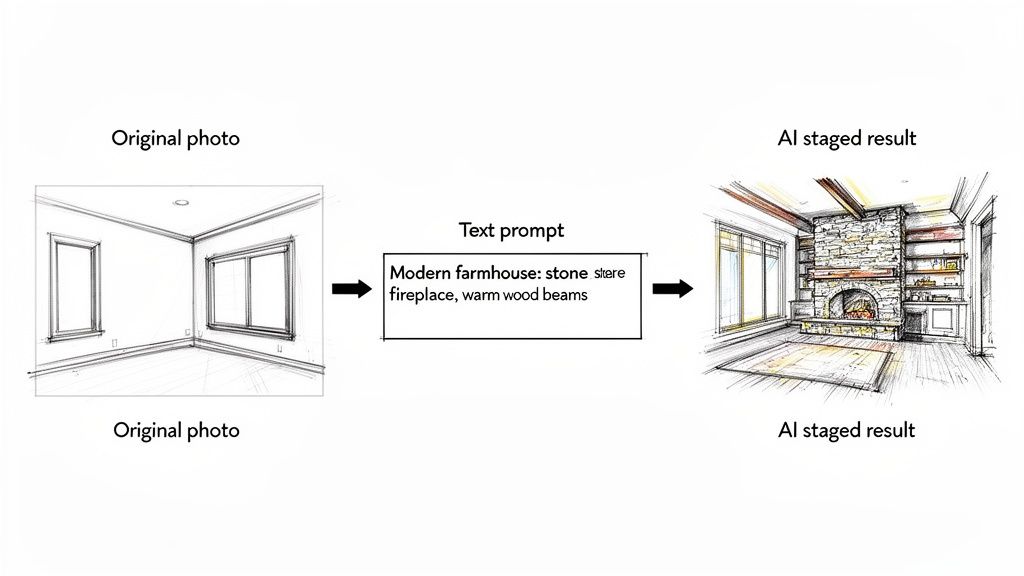
Getting started with AI for visual marketing is probably much faster and easier than you imagine. Today’s tools are designed to be simple, using text prompts—basically, just describing what you want—to produce incredible results.
Here’s a quick look at how it typically works:
- Upload Your Starting Image: You start with what you have. This could be a photo of an empty room, an export from a 3D model, or even a basic floor plan. The AI uses this as its canvas.
- Describe Your Vision: This is where the fun begins. You just type what you want to see into a text box. Your prompt can be short and sweet or packed with detail.
- Generate and Refine: In about 30 seconds, the AI processes your request and creates a photorealistic image. If it’s not quite right, you can simply tweak your prompt and generate new versions until it’s perfect.
This ability to iterate on the fly is a massive advantage. You can experiment with multiple design styles—from Scandinavian minimalist to modern farmhouse—in the time it would take just to get a quote from a traditional stager.
Think of the AI as your personal design assistant. It does all the heavy lifting—the complex rendering and lighting calculations—so you can focus entirely on the creative vision for the property. You're the director; the AI is your production crew.
From Prompt to Perfect Picture
Let's make this real. Imagine you have a photo of a vacant bedroom with great natural light. Instead of just listing its dimensions, you can show buyers what’s possible.
You could start with a simple prompt like this:
- "A Japandi style bedroom with a low-profile wood bed, neutral linens, a large jute rug, and a single piece of minimalist art on the wall."
Seconds later, the AI delivers an image that brings that vision to life. But what if you want to appeal to a different type of buyer? You could easily change the prompt to something completely different:
- "A warm industrial style bedroom with an exposed brick wall, a black metal frame bed, and Edison bulb pendant lights."
This power to instantly create and compare styles gives you incredible marketing flexibility. You can craft targeted social media posts, breathe new life into stale listings, or give clients a visual mood board for their potential new home.
If you're ready to jump in, you can explore the best virtual staging software that makes all this possible. With tools like these, you can unlock a property's true potential and help buyers fall in love before they even walk through the door.
Putting AI to Work in Your Real Estate Business
Diving into new technology can feel like a huge commitment, but bringing AI into your real estate marketing doesn't mean you have to tear down your current systems and start from scratch. The smartest way to begin is by picking one real problem and solving it. This way, you get a tangible win right away, which builds the confidence and momentum you need to do more.
The point isn't to become an AI guru. It's about finding a smart tool that makes your life easier. Think of it less like learning a new programming language and more like hiring a super-efficient assistant. Start by asking yourself: what's my single biggest bottleneck? Where am I losing the most time? Is it writing compelling listing descriptions, chasing down lukewarm leads, or getting marketing visuals ready for a new property?
Once you’ve zeroed in on that specific pain point, you can find an AI tool built for exactly that job. This keeps you from getting lost in the sea of options out there.
Start Small, Win Fast
A "start small, win fast" mindset is everything here. Don't try to roll out a massive, AI-driven CRM system on day one. Instead, pick a single task where you can make a big impact quickly. For instance, if creating stunning visuals is a constant headache, a tool for virtual staging or photorealistic rendering is the perfect place to start.
Here's a simple, step-by-step way to approach it:
- Find Your Biggest Time-Sink: Be brutally honest. Is it writing ad copy? Managing your lead pipeline? Prepping photos? Pinpoint what bogs you down the most.
- Pick One High-Impact Tool: Choose an AI solution that attacks that one problem head-on. Don't try to boil the ocean.
- Set a Clear, Measurable Goal: Decide what a "win" looks like. For example: "I'm going to use AI to virtually stage my next three listings and compare their online views to my last three unstaged ones."
- Test and Measure: Use the tool for a set period and track the results against your goal. Did you save hours? Did you get more inquiries?
- Build on Your Success: Once you've seen real value in one area, you can start looking for the next bottleneck to solve with confidence.
Think of adopting AI as a marathon, not a sprint. Proving the value with one small, successful project is the best way to get buy-in from yourself and your team, making it much easier to embrace new tech down the road.
Getting Your Team On Board
If you're part of a team or brokerage, bringing in AI is all about communication. You need to frame it as a tool that helps everyone do their best work, not something that's here to replace them. Position AI as an assistant that takes care of the grunt work, freeing up agents to focus on what they do best: building relationships, negotiating deals, and closing sales.
A great way to start is with a small pilot program. Ask one or two tech-friendly agents to try a new tool and report back. Nothing is more convincing than a real success story. Showing that a property sold 20% faster after being virtually staged with AI will do more to win people over than any slideshow ever could. To see how these tools are built specifically for agents, check out our guide on AI solutions for real estate agents. This steady, results-first approach helps make AI a welcome new teammate, not a disruptive force.
How to Know If Your AI Marketing Is Actually Working (And Paying for Itself)
Adopting new tech is one thing, but proving it’s making you money is another. When you start using AI for real estate marketing, you absolutely have to track your return on investment (ROI). This isn't about a fuzzy feeling of being more "modern"; it's about connecting your AI efforts to real numbers that affect your bank account.
Think about it—you'd never run a Facebook ad campaign without checking the results, right? The same logic applies here. By setting clear goals and watching the right Key Performance Indicators (KPIs), you can shift from just using AI to strategically investing in it.
This approach gives you the hard data you need to justify the cost, pour more resources into the strategies that are crushing it, and make smarter decisions for your business.
Key Metrics for AI-Powered Visuals
When you’re using AI for virtual staging or creating photorealistic renders with a tool like MoldaSpace, the whole point is to grab a buyer's attention and get them to take the next step. So, your metrics need to reflect that.
You have to look past simple view counts and zero in on the kind of engagement that actually leads to a sale.
- Click-Through Rate (CTR): Are more people clicking on your listings from Zillow or your own website? Stunning, AI-generated visuals are one of the most powerful ways to boost that CTR.
- Days on Market (DOM): This is the ultimate test. Track the DOM for your properties marketed with AI visuals and compare it to your average. A shorter time on market is money straight back into your pocket.
- Inquiry and Tour Requests: Keep an eye on the number of DMs, emails, and scheduled tours you're getting. Better visuals should always translate into more serious, motivated buyers reaching out.
Here's a simple way to think about it: "Did this AI-generated image get me more genuine buyer interest than a photo of an empty room ever did?" If the answer is a clear yes, you know you're heading in the right direction.
Tracking Automation and Lead Management
For the AI tools that handle things like lead scoring or writing property descriptions, the ROI comes down to two things: efficiency and conversion.
You're essentially measuring both the time you get back and the new revenue you're generating.
- Time Saved Per Task: Figure out how many hours you used to burn writing listing copy or chasing down cold leads. That time is now free for dollar-productive activities, and it has a clear monetary value.
- Lead-to-Appointment Rate: Are your AI chatbots or lead scoring systems actually booking more solid appointments? A jump in this number is a direct boost to your sales pipeline.
- Lead Conversion Rate: This is the big one. You need to measure the percentage of leads that turn into closed deals. A higher conversion rate is proof that your AI is doing its job by finding and nurturing your best prospects.
By keeping a close eye on these specific KPIs, you can paint a crystal-clear picture of how AI for real estate marketing is performing. This isn't just about playing with new gadgets; it's about making a measurable, undeniable impact on your business's bottom line.
Using AI Ethically and Building Client Trust

As you start weaving AI for real estate marketing into your workflow, building and maintaining client trust is absolutely paramount. These tools give you a serious edge, but that advantage disappears quickly if you aren't using them responsibly. The whole game comes down to being upfront in your marketing and fiercely protective of client data.
It helps to think of AI as just another powerful tool in your toolbox—it doesn't replace your professional judgment or your integrity. When you're using AI to create stunning visuals or chat with potential leads, your ethical compass needs to point in the same direction it always has. Honesty is everything.
Transparency in Visual Marketing
When it comes to virtual staging or photorealistic renders, being transparent isn't optional. These visuals are fantastic for helping buyers imagine a property's potential, but they should never, ever be misleading. Showing an empty room filled with beautiful AI-generated furniture is a brilliant marketing move, as long as everyone knows what they're looking at.
A simple, honest disclosure is all it takes to keep things clear:
- Add a small watermark or a discreet text overlay saying "Virtually Staged" or "Artist's Rendering."
- Include a quick note in your listing description, something like, "Some images have been digitally furnished to help visualize the home's layout."
This small step prevents any "gotcha" moments and immediately signals to buyers that you're an agent they can trust.
Adopting a policy of clear disclosure doesn't weaken your marketing—it strengthens your credibility. Buyers appreciate knowing what's real versus what's a digital representation, building trust from the very first click.
Protecting Client Data and Privacy
Beyond the visuals, AI tools like chatbots and smart CRMs are often handling sensitive client information. Guarding that data isn't just a good idea; it's a fundamental part of your job. Before you commit to any AI platform, make sure it has rock-solid security protocols.
Be open with clients about how their information is used. If a chatbot is asking for their name and number, a simple disclaimer lets them know what's happening. This shows you respect their privacy and reinforces their confidence in you as a professional.
Got Questions About AI in Real Estate? Let's Clear Things Up.
Even when you see the potential, jumping into new technology always brings up a few "what ifs" and "how tos." Let's tackle some of the most common questions real estate pros ask when they're thinking about adding AI to their marketing toolkit. My goal here is to give you straight answers so you can move forward feeling confident.
Do I Need to Be a Tech Whiz to Use These Tools?
Absolutely not. Think of it this way: the newest wave of AI marketing tools was designed for real estate agents and designers, not software engineers. Many platforms, especially the ones focused on visual marketing, have incredibly intuitive interfaces that let you get professional-grade results without touching a single line of code.
Forget complicated settings and confusing menus. You’re basically just telling the tool what you want in plain English. For example, you might type, “Create a bright, modern farmhouse kitchen with a large island and marble countertops,” and the AI does all the heavy lifting in the background. The entire point is to be user-friendly, letting you create amazing things without a frustrating learning curve.
Is This Stuff Too Expensive for a Solo Agent or Small Brokerage?
The cost of AI tools can be all over the map, but you'd be surprised how affordable many of the best ones are. The industry has really moved away from giant, scary annual contracts and toward much more flexible, budget-friendly models.
For instance, many visual AI platforms run on a simple pay-as-you-go credit system. This is a game-changer. It means you only pay for the specific images or videos you generate, which is perfect for a solo agent managing a few listings or a small firm watching its budget. This approach lets you tap into high-end technology as you need it, without the big upfront investment.
Is AI Going to Take My Job?
Let's be clear: AI is an assistant, not a replacement. A very, very powerful assistant. It’s fantastic at handling the tedious, data-driven tasks that eat up your day. This frees you up to double down on what only a human can do: build trust with a nervous first-time buyer, negotiate a tricky deal, and use your years of experience to read the subtleties of the local market.
An AI can generate a perfect virtual staging in seconds, but it can't look a client in the eye and understand their deep connection to a specific neighborhood. It can't navigate the emotional rollercoaster of a bidding war. Think of it as a tool that supercharges your skills, making you dramatically more efficient and effective at your job.
Ready to create stunning visuals that stop buyers in their tracks? MoldaSpace can turn your empty room photos into photorealistic, professionally staged images with just a few clicks. Try it for free and see for yourself how easy it is to make your listings look incredible.